
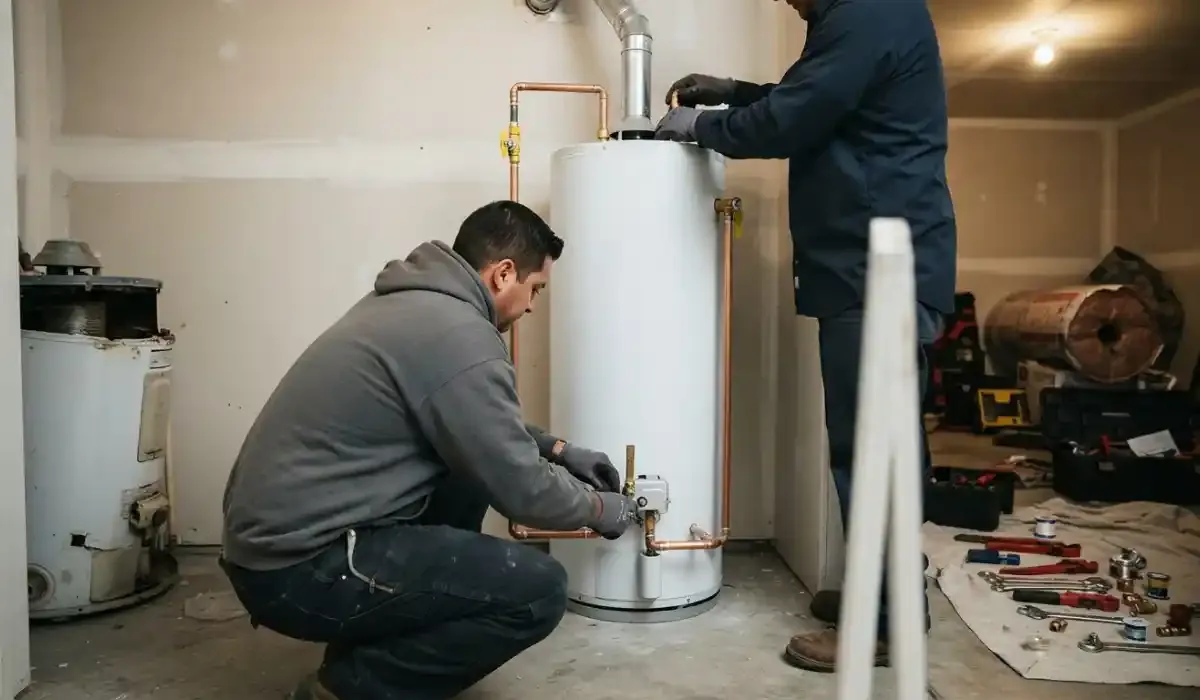
What a good installation includes
A water heater installation is more than setting a tank on the floor. The plumber confirms there is room, checks that the fuel supply is adequate and sets the tank on a stand or pan where needed. Next come the water lines with shutoff valves, then the temperature and pressure relief valve piped to a safe discharge. The unit is tested before the plumber leaves.
Gas units add a venting step. The flue must rise with proper clearance and draw correctly, and a gas shutoff and sediment trap are required on the supply. Electric units need a circuit of the right size and a disconnect within reach.
Water heater installations follow the International Plumbing Code (IPC) and, for gas units, the International Fuel Gas Code, including the relief valve, discharge pipe and venting rules.
What to settle before installation day
- Where the unit will sit, and whether a drain pan is needed under it.
- Gas or electric, and whether the existing line or circuit is adequate.
- Whether the house has a closed system that needs an expansion tank.
- Who pulls the permit and who schedules the inspection.
- How the old unit, if any, will be removed.
Types of water heaters compared
| Type | Good for | Watch for |
|---|---|---|
| Gas tank | Households with a gas line and fast recovery needs | Venting and combustion air |
| Electric tank | Homes with no gas service | Slower recovery and a dedicated circuit |
| Tankless gas | Small spaces and on-demand hot water | Larger gas line and proper venting |
| Tankless electric | Small homes and point-of-use needs | Very high electrical load |
Garages, closets and attics in El Reno homes
Many Canadian County homes place the heater in a garage or a utility closet. A garage unit must be protected from vehicle impact and from ignition sources, and a closet needs enough combustion air. Attic installations need a drain pan with a drain line, because a leak there damages a ceiling.
Winter matters here too. A heater in an unheated garage works harder, and exposed supply lines can freeze. Insulating the lines is cheap compared with a burst pipe, and the plumber can point out which pipes are exposed.
Ready to schedule?
Call and tell us what you are installing. A plumber can be scheduled the same day when available.
Licensing and permits
The Oklahoma Construction Industries Board licenses plumbers statewide, and El Reno's code asks plumbing contractors to be registered with the city as well. A homeowner may be allowed to work on their own residence under the code's exemptions, but gas and venting work is risky for a non-professional.
Call El Reno Community Development at 405-262-2000 to ask about permit and inspection rules before you start, and ask your plumber to put the permit status in writing.
What affects installation cost
Water heater installation questions
The line is answered 24/7 and a plumber is scheduled the same day when one is available. A planned install in a new location may take longer because of materials and permits.
Often yes, but it means new water lines, venting and possibly a new gas line or circuit. The plumber will check what is possible and explain the cost before starting.
Where the system is closed, for example with a check valve or pressure reducing valve at the meter, yes. The plumber will check and install one if needed.
It depends on how many people use hot water and when. Ask the plumber, and mention the number of bathrooms and whether you run a dishwasher and washer at the same time.
In attics and above finished spaces, yes under common code practice. Ask the plumber, since local rules apply.
Related services
Failed tank
See water heater replacement for emergency swaps.
Other new fixtures
Plumbing installation covers fixtures, lines and remodel rough-ins.
Treat the water
A water softener protects a new tank from scale.