
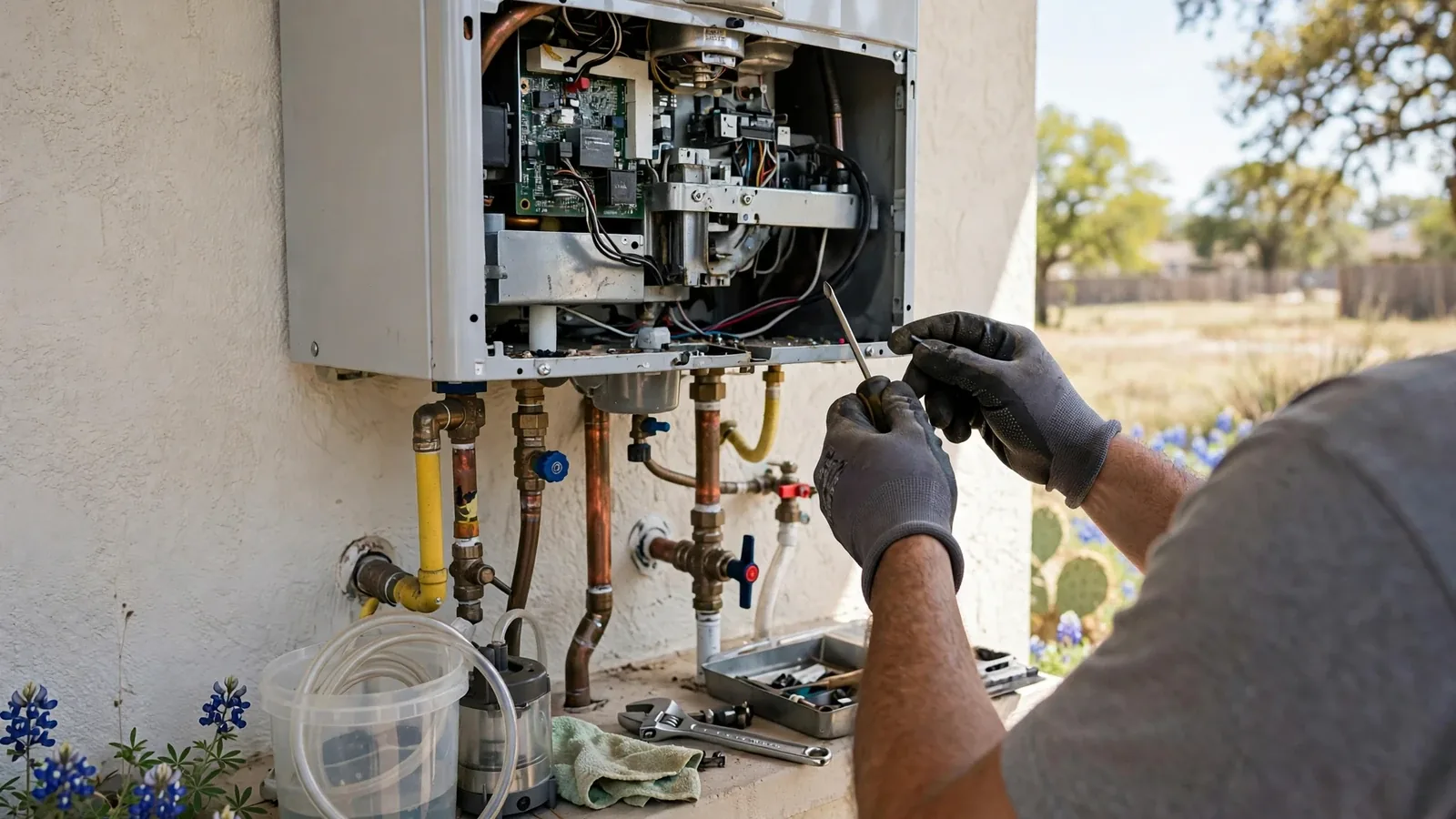
What changes when you go tankless
A tankless unit uses a burner or elements to heat water as it flows through a heat exchanger. Because it only works when water is running, there is no standby tank to keep warm, and the unit mounts on a wall.
The trade-off is demand. A gas tankless unit commonly needs a larger gas line than a tank unit and a vent rated for its type. An electric unit can draw a large amount of current and may need a heavy circuit. A plumber confirms both before you buy.
Gas tankless installations follow the International Fuel Gas Code and the manufacturer's listed vent instructions, while electric units follow the National Electrical Code (NEC) for circuit and breaker sizing.
Tankless versus tank
Tank heater
- Lower upfront cost
- Simple, familiar repairs
- Runs out when the tank is empty
- Uses floor space
Tankless heater
- Hot water as long as the flow is within capacity
- Wall mounted, saves floor space
- Needs sized gas and venting
- Needs descaling in hard water
Neither is always better. A large family with frequent back-to-back showers tends to benefit from tankless, while a small household may be happier with a tank and a lower bill for the unit.
Flushing and scale in tankless units
The narrow passages inside a tankless heat exchanger collect mineral scale from hard water. A scaled exchanger runs hotter, delivers less flow and may throw an error code. Flushing with a descaling solution, usually once a year, clears it.
If you do not know your water hardness, a hardness test strip answers it, and the City of El Reno can tell you about its supply. Pairing a tankless unit with a water softener reduces how often it needs flushing.
Tankless unit not heating?
Call the 24/7 line with the error code. A plumber can be scheduled the same day when available.
Common tankless problems
| Problem | Likely cause | Typical fix |
|---|---|---|
| Error code and no hot water | Scale, flame sensor or venting fault | Descale or clean the sensor |
| Water turns cold midway | Flow too low for the unit to fire | Clean the inlet filter or raise flow |
| Sandwich of hot and cold | Dead water in the line between uses | Recirculation or a small buffer tank |
| Ignition failure | Gas supply or igniter fault | Check the gas line and igniter |
Venting and gas safety
Call before you restart a unit that shut itself off
A tankless unit that shuts down is often protecting itself.
- Gas units must vent exhaust outdoors through the correct vent material.
- A blocked or disconnected vent can let carbon monoxide into the house.
- Install carbon monoxide alarms near sleeping areas.
- If you smell gas, leave and call the gas utility from outside.
What affects the cost of a tankless job
Tankless water heater questions
Yes. The line is open 24/7. A licensed plumber is scheduled the same day when one is available. Have the brand, model and any error code ready when you call.
It can reduce standby heat loss, but the unit and the gas or electrical upgrades can cost more at the start. The savings depend on how much hot water your household uses.
Commonly once a year, more often in hard water. Check your manufacturer's manual, and ask the plumber if your water is known to be hard.
Low flow is a common reason. If the flow is below the unit's minimum, it will not fire. A clogged inlet screen or a mostly closed faucet can cause it.
Often yes, but gas line size, venting and clearances must be checked. Older homes may need upgrades, and the plumber will tell you before you commit.
Related services
Tank unit
Water heater repair covers tank heaters that still have life.
New install
Water heater installation describes planning and permits.
Treat the water
Water softener and filtration protects the heat exchanger.