
What to expect from each type
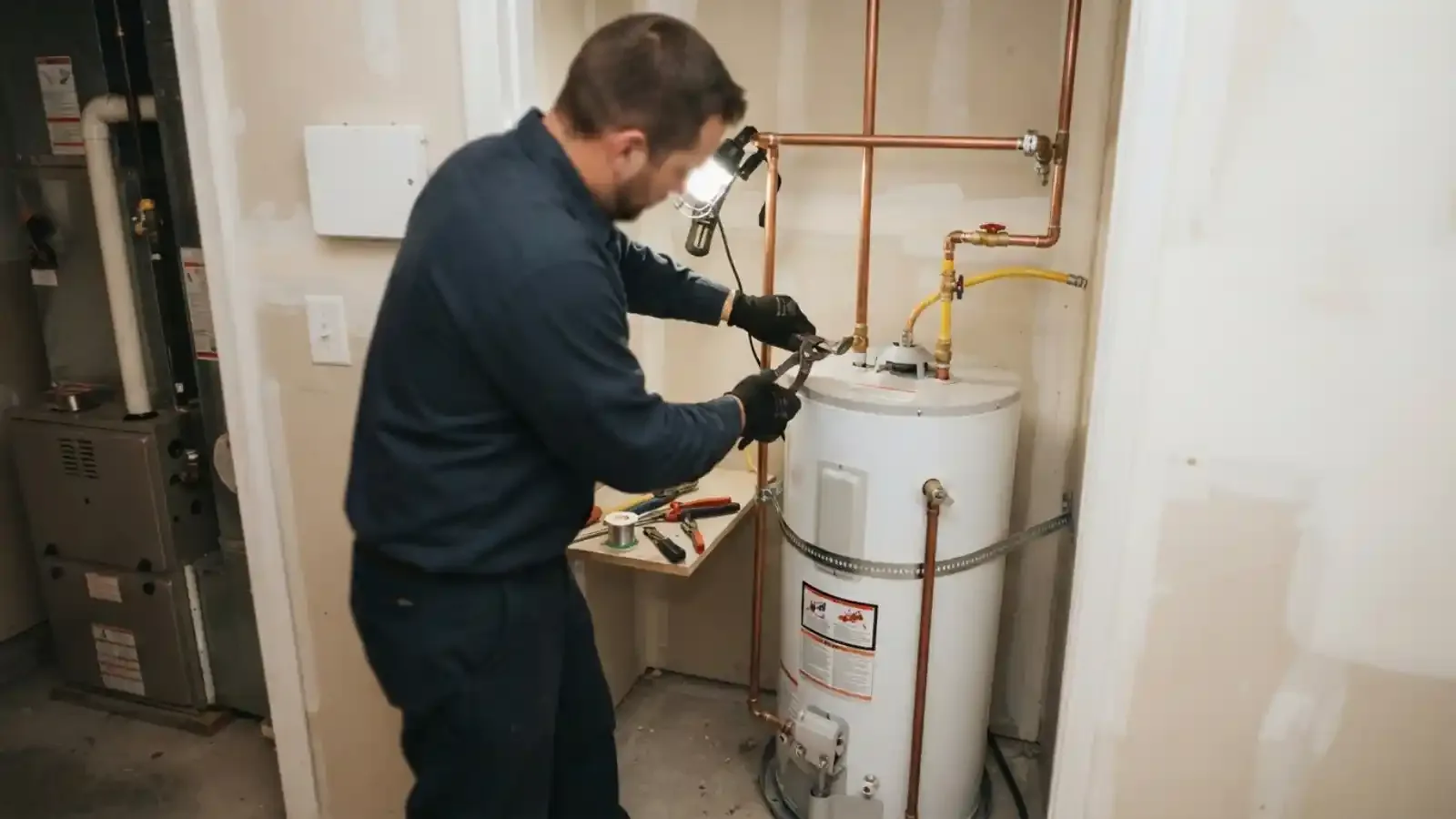
A gas or electric tank commonly lasts around ten years. The steel tank has a glass lining and a sacrificial anode rod that corrodes first, protecting the tank. Once the rod is spent, the tank itself begins to corrode, and a leak is a matter of time.
Tankless heaters have no storage tank to rust, and their parts can be replaced, so they often last longer. The tradeoff is that mineral scale inside the heat exchanger needs flushing, usually once a year, and neglected units fail early.
Test the relief valve the way the manufacturer's manual describes, since the International Plumbing Code (IPC) requires one on every storage water heater.
Repair or replace?
| Situation | Usually best | Why |
|---|---|---|
| Tank under about eight years, simple part failed | Repair | The tank still has life |
| Tank past ten years with a repair needed | Compare both | Money into an old tank may be wasted |
| Water at the tank body or seam | Replace | The steel has failed |
| Rusty hot water only | Check the anode rod, then decide | Corrosion may be inside the tank |
| Tankless with an error code | Descale and test | Scale is a common cause |
How to find your heater's age
The data plate on the side of the tank has a serial number. Many manufacturers encode the month and year in the first digits, and the brand's website or a plumber can decode it. If the label is faded, look at the installation date on your paperwork or any permit.
If you bought the house with the heater in place and cannot find the date, assume it is older than you think and plan accordingly. A heater of unknown age that is rusting or leaking is not a candidate for an expensive repair.
Signs the tank is near the end
Rumbling and popping at heat-up means sediment has built up and is boiling under the burner or around the element. Rust-colored water, moisture at the base, a stained drain pan and fluctuating temperatures are all signs. Water pooling under the tank is the final warning, because it means the steel liner has failed.
When any of these appears on a heater past eight years, begin pricing a replacement. A planned swap costs less than an emergency one, and you can choose the model instead of taking whatever is on the truck. Read our water heater replacement page for what is involved.
Habits that add years
Flush the tank once a year to remove sediment. Test the relief valve by lifting its lever briefly, and check that water flows and then stops. Look at the anode rod every few years, and replace it when it is mostly consumed. Keep the thermostat at a moderate setting, since hotter water speeds scale and corrosion.
If you notice scale on your faucets and showerheads, ask about a water softener, which protects the heater and every fixture.
Build a replacement plan before you need one
Decide where the heater is, whether you want to stay with gas or electric, and whether you are open to tankless. Measure the closet. Note the vent type. Then you can get a clear price instead of reacting to a failure.
If you are remodeling or adding a bathroom, a larger tank or a second unit may make sense. A plumber can size it. See water heater installation for planning steps.
What it costs to wait too long
The most expensive heater failure is the one nobody expects. A tank that fails at night can spill dozens of gallons onto flooring, drywall and stored items before anyone notices. The same tank replaced a month earlier costs only the price of the unit and the labor.
If your heater is old and located above living space, such as in an attic or on an upper floor, add a drain pan with a drain line, and consider a leak sensor. These cost little and can send an alert before a small leak becomes a ceiling collapse.
Does a new heater save money?
Newer tank heaters have better insulation and are more efficient than units made twenty years ago, so a replacement can lower standby losses. The gain depends on the old unit and on your hot water use. Tankless units avoid standby loss entirely, but they cost more to install and need gas and venting upgrades in many houses.
A plumber can explain the difference for your household. Do not choose on a claimed savings number alone. Choose on fit, reliability and the quality of the installation.
Local water and local rules
The City of El Reno supplies its own water, and you can request its water quality report from the utility office at 405-262-4070. Hardness varies by source, and hard water leaves scale that shortens a heater's life. A hardness test strip gives you a quick number if you cannot find the report.
A replacement often needs a permit, which El Reno Community Development at 405-262-2000 can explain. Homes in Yukon and Piedmont are covered by those cities' own rules.
Source type: City water utility and building department
Questions El Reno homeowners ask
Read the serial number on the data plate and decode it with the maker's guide, or ask a plumber. Permit records and purchase paperwork also help.
Not necessarily. Watch for leaks, rust and noise. If it is working well, you can plan a replacement rather than rushing.
Yes. Scale adds stress to elements and burners and collects at the tank bottom. A softener or regular flushing helps.
It depends on gas line size, venting and usage. A plumber can check what your house needs.
Our line is answered 24/7, and a plumber is scheduled the same day when one is available. If the tank is leaking, shut off the water and call.