
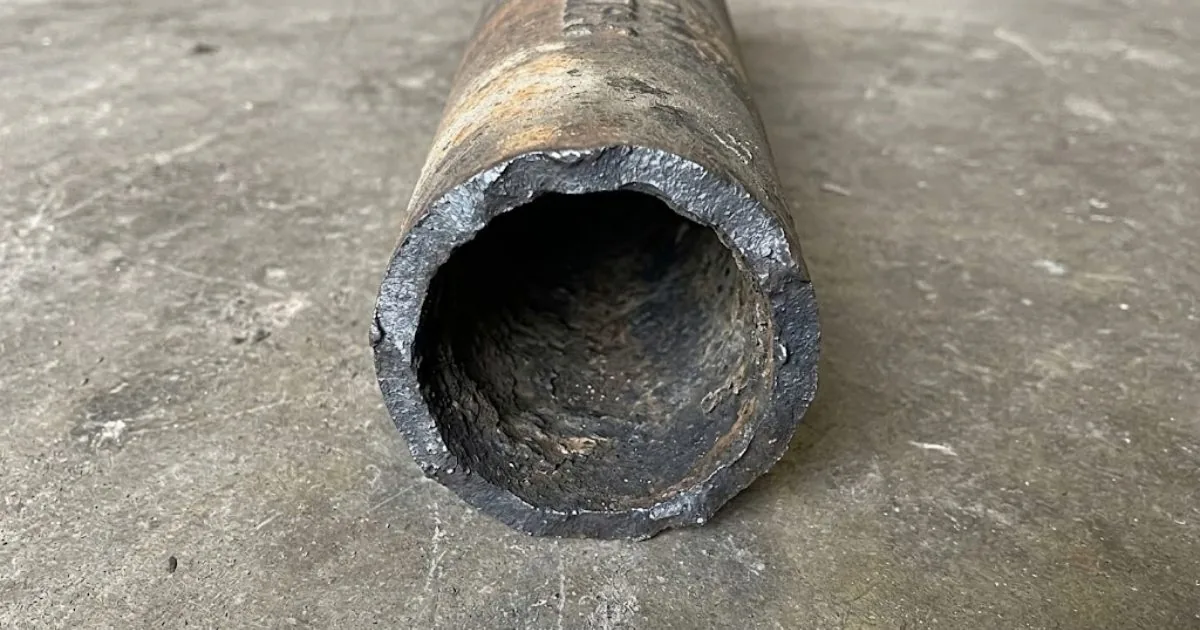
Why cast iron lasts, and why it eventually fails
Cast iron is quiet and fire resistant, which is why builders used it for drain stacks and building sewers for much of the twentieth century. Over decades, though, waste and moisture corrode the inside wall. Rust nodules, called tuberculation, build up and narrow the pipe, and they catch paper and grease.
The outside can rust too, especially where a pipe sits in damp soil or a wet crawlspace. A pipe that looks fine from the outside can be paper-thin underneath.
Replacement sections are normally made with PVC drain pipe that meets ASTM D2665, joined with couplings that suit the International Plumbing Code (IPC), while hubless cast iron soil pipe is covered by CISPI 301 and ASTM A888.
Signs a cast iron line is failing
| Sign | Likely cause | Next step |
|---|---|---|
| Repeated clogs in the lowest drains | Rust scale narrowing the pipe | Camera and cleaning |
| Sewer odor near walls | Leak at a joint or crack | Locate with a camera |
| Stain on a ceiling below a bathroom | Stack or hub leak | Open and inspect |
| Rust-colored drips | Corroded pipe wall | Repair or replace |
| Gurgling and slow flow | Narrowed pipe or partial blockage | Cleaning, then a decision |
Where you meet cast iron around El Reno
El Reno was incorporated in 1890, and the older blocks near the Rock District and the Carnegie Library have houses and storefronts that predate modern plastic drain pipe. In those buildings, cast iron may still run through the walls, under the floor and out to the street.
Homes built from the 1950s through the 1970s often used cast iron for stacks and sometimes for building sewers, with clay or other materials beyond. If you own one of those, a camera look at the line can tell you what you have and how long it may last.
Old pipe leaking?
Call the 24/7 line. A licensed plumber can be scheduled the same day when available.
What to do when an old drain pipe is leaking
Protect the house while you wait
A leaking drain stack carries sewage, so treat the water as contaminated.
- Stop using the fixtures that drain into the leaking pipe.
- Keep children and pets out of the wet area.
- Place a bucket or towels to catch drips, and wear gloves if you must clean up.
- Call the 24/7 line and say where the pipe is leaking.
Repair choices for cast iron
Clamp or sleeve repair
A rubber coupling or a clamp on a short cracked section. Fast, and it fits when the rest of the pipe is sound.
Section replacement
Cut out the bad section and splice in new pipe, often PVC with a transition coupling.
Lining
A cured liner inside the old pipe. It needs a pipe that is intact and clean.
Full replacement
Replace the stack or the line when corrosion is widespread.
How a plumber approaches an old line
The plumber clears the line, runs a camera and marks the failures. A short failed section may be a clamp or sleeve repair. A line with scale and cracks in several places points toward replacement. The plumber should explain the options and show the footage.
Cast iron is heavy and old joints can break when disturbed, so cutting must be done with care. A permit may be needed for replacement. Ask El Reno Community Development at 405-262-2000, and confirm your plumber's license on the Oklahoma Construction Industries Board lookup. See sewer line repair for related options.
What affects the cost
Cast iron pipe questions
Our line is open 24/7. A licensed plumber is scheduled the same day when one is available. A leaking drain stack is treated as urgent.
Often fifty years or more, depending on conditions. Corrosion decides the limit.
Yes, when the damage is limited. A camera shows whether a repair or replacement fits.
Often yes, but hard scraping can break a thin wall. A camera look first is wise.
Usually not for wear. Sudden damage may be covered. Ask your agent.
Related services
Camera first
Sewer camera inspection shows the condition of the line.
Cleaning
Hydro jetting removes scale when the pipe is sound.
Whole-house work
Repiping covers supply lines in old houses.